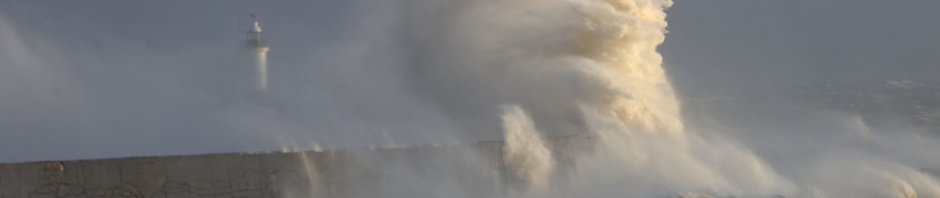
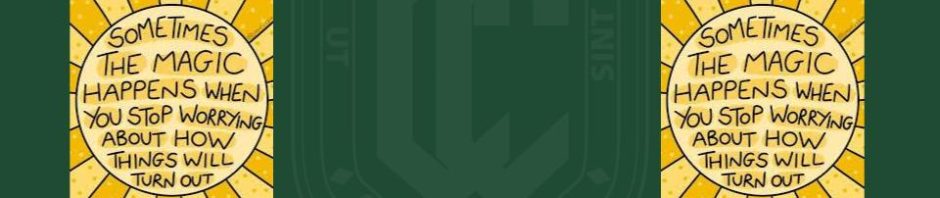
Back in January, I wrote about ‘Making the Magic Happen in 2026’. Since then, the weather has seemed determined to test that optimism. The rain has been relentless, and at times the year has felt more grey than glittering. But perhaps that is when magic matters most.
Real magic is not sunshine-dependent. It is the steady confidence of a community that knows who it is and why it does what it does. If anything, these damp weeks have sharpened my conviction: the magic at Claires Court is built daily — deliberately, consistently and together. I’ve attended almost every parents’ evening over the past 3 weeks, sat through concerts, stood on the muddy touchlines, and led some assemblies, too. Indeed, so much has sparkled.
My commitment to leading this school is both professional and deeply personal. Founded in 1960 by my parents, David and Josephine Wilding, Claires Court has shaped my life. My brother Hugh and I were among the first 19 pupils to walk through its doors, and for over 45 years—now well into our fifth decade of leadership—we have had the privilege of guiding this community. This is not simply a role; it is a calling.
We have not just led the school — we have lived it. Our own children were educated here before heading to university, equipped with resilience, confidence and the ability to communicate and lead. Now, as I welcome my grandchildren, that circle begins again, reinforcing my determination to preserve the “village” that sustains us.
Yet warmth alone is not enough. Parents choose Claires Court for the uncompromising quality of our academic education. Community gives us heart; intellectual rigour gives our students their future. Whether joining at 11+, 16+, or leaving after Sixth Form, every pupil is here to develop the mastery that unlocks the next stage of life — not simply to pass tests, but to thrive beyond them.
We also understand the “independence paradox”. As young people grow, they seek space — sometimes wishing their parents invisible at the school gate — even as academic pressures intensify. Our task is to honour that independence while ensuring no student walks alone. We provide structure, expectation and encouragement, allowing pupils to feel ownership of their success, supported quietly but firmly in the background.
The magic lives in how we bridge childhood and adulthood. A moment on stage or on the sports field may begin in joy, but it develops discipline, courage and teamwork. Play evolves into character. By the time our students leave, they do so not only as capable scholars but as grounded young adults who carry the strength of their village with them.
After fifteen years of blogging, one might ask what becomes of a story when its original author steps aside. At Claires Court, the answer is simple: the story was never about one pen. It lives in second-and third-generation families, among former pupils who return as parents and staff, and in values that outlast individuals.
The rain will pass. We can only hope – next week is Half-Term!
The magic endures — because it is written collectively, by a community that continues to shape its future, whatever the forecast.
I’ve written the following thought piece to illustrate there are no easy answers for anyone in the education space in 2026. Probably true for most ‘human’ providers, from farmers, through care and health to pubs and the hospitality trade.
The state of the UK independent sector in early 2026 feels a bit like waking up the morning after a particularly rowdy party: the initial shock of the 20% VAT policy has finally moved into the rear-view mirror, but we are now left surveying the carpet stains and wondering where the furniture went.
We have moved from outrage and blind panic to a more sober phase of taking stock. Most leaders are no longer head-butting the inevitable; instead, they are trying to lean into each bend of a new and still unsettled reality. This is less ‘heroic’ transformation and more careful ‘driving in the rain’.
The View from the Rollercoaster
It has not been all doom and gloom, though “gloom-adjacent” remains a fair description. There are flashes of light in the storm. The QED Schools Group’s acquisition of Wycliffe College is a reminder that parts of the sector remain resilient and, crucially, investable. Schools with a genuinely premium proposition, or with a loud and credible public-benefit footprint, are holding their ground. And there is still dependable demand from international families, whose enduring affection for elite UK boarding suggests that the Hogwarts aesthetic is, for now at least, VAT-resistant. If nothing else, British boarding still photographs extremely well.
Another constructive development has been the arrival of the Association for Families of Independent Schooling (AFIS). This new advocacy group gives parents a collective voice in debates that have often felt remote and top-down. At a time when VAT hikes and funding pressures are reshaping family choices, AFIS converts individual frustration into organised representation. Its importance lies not just in amplifying parental concerns, but in reminding policymakers—particularly MPs—that these parents are also voters, spread across constituencies nationwide. By helping to bridge the gap between schools and families, AFIS may yet play a role in nudging the debate towards more balanced and workable reforms.
That said, the sector-wide rewiring is well under way, and the ride remains bumpy.
The enrolment cliff: Some 11,000 and 13,000 pupils have already left the sector, circa round a 3% drop Clearly the exodus can only grow, as no doubt the 2026 ISC census will show. The impact has fallen disproportionately on middle-income families, many of whom have concluded that independent education is a discretionary luxury they can no longer justify—particularly when the weekly shop itself has begun to feel like a luxury item.
The Hunger Games: A number of schools, including well-known Rendcomb College, Palmers Green and Longacre School, plus prep school elements of other schools/groups have already announced their exit from the market or consolidations onto one site as rising costs collide with falling rolls.
The shared-pressure club: Independent schools are not alone. Universities, state academies and nurseries are grappling with the same workforce shortages, affordability constraints and cost inflation. Pension pressures, recruitment and retention challenges, energy costs and employer National Insurance and minimum wage rises are hitting across the system. It is not quite solidarity, but it is at least shared discomfort.
Policy headwinds: The Secretary of State for Education, Bridget Phillipson, has maintained a sustained focus on independent provision, particularly within SEND, arguing that some placements are high-cost and ineffective while advocating a “mainstream-first” model. These pressures sit alongside a wider policy agenda that continues to increase financial strain across both state and independent sectors. There is a notable tension here: while domestic provision faces VAT and regulatory headwinds, the government’s International Education Strategy actively encourages leading independent schools to expand overseas as part of a £40bn education-exports ambition by 2030. The contrast has not been lost on the sector.
The legal cliffhanger: In January 2026, the Court of Appeal heard arguments that the VAT policy is disproportionate and incompatible with human-rights obligations. A written judgment is expected in late March or April. A declaration of incompatibility would place real pressure on the government to revisit the Finance Act, leaving the next twelve months pencilled in rather than set in stone.
Survival Tips for the Time-Poor Head
For leaders of small junior schools in particular, “time-poor” barely does justice to the reality. The ambition for 2026 is not grand transformation, but operational resilience: rebuilding enough of the school’s operating spine to withstand sustained pressure without snapping. This is not the year for glossy strategy decks.
What follows is a deliberately pragmatic survival guide, built around delegation rather than heroics.
Lean on your board: If you have an effective chair, hand over long-term strategic projects—digital transformation, estate rationalisation, structural partnerships. Your focus should be on running the school day to day, not designing a vision for 2030.
Redeploy proprietors: Where schools have owners, their energy is often better spent rebuilding community relationships and external partnerships than micromanaging operational detail.
Explore co-operative back offices: Shared IT, HR, finance or estates services within a trust or local cluster can materially reduce costs without undermining autonomy.
Adopt a hybrid staffing model: Employ teachers where scale justifies it, but partner with high-quality online providers for low-demand or niche subjects. Preserve in-person capacity for the experiences that genuinely require it.
Sweat the assets: Grounds and facilities are frequently under-used. From summer camps to short-stay accommodation or specialist programmes, ancillary income can be generated without wholesale reinvention.
Approach SEND strategically: Expanding into SEND provision can help fill capacity and attract local-authority funding, but it must be done with political awareness and genuine quality. Current policy rhetoric favours mainstream inclusion and remains sceptical of independent special provision. Any move in this direction should therefore be framed as collaborative, regionally integrated and outcomes-driven.
Support advocacy: Encourage staff and parents to engage with AFIS and similar bodies. Schools can facilitate participation, but parental voices carry particular weight. In a charged policy environment, coordinated advocacy matters.
The year ahead is about surviving demographic contraction and maintaining operational viability. It is unlikely to be elegant. But then, survival rarely is—and it is still preferable to shutting the gates.
For fifty years, I have witnessed the evolution of education from the classroom frontlines. As a headteacher, I introduced the National Curriculum with optimism, only to see later reforms push high-stakes testing and diminish children’s creative writing. In response, my school designed a question-based curriculum, prioritising curiosity and creativity alongside knowledge and analysis. Today, only GCSEs remain as high-stakes tests at my school, but my concerns go deeper.
To add weight to this blog, here’s news of a national petition to highlight why play is so important
What worries me most is the gradual erasure of unsupervised play from children’s lives. The relentless focus on attainment and ‘outcomes’ has crowded out the spontaneous world where children explore, fail, and grow resilient. Children now face schedules packed with adult-led activities, which deprive them of opportunities for self-discovery and independence. This is not just a loss of leisure—it’s a loss of the safe space to fail and learn, a vital part of developing an internal sense of control and adaptability.
I see this even more clearly as a grandparent. My grandchildren, in private nurseries and independent schools, benefit from open-ended play and choice. Here, oracy and decision-making are valued as much as traditional skills. Heuristic play, rooted in the Greek concept of “discovering for oneself,” is central. Research and biology agree: play isn’t a break from learning—it is its most sophisticated form, nurturing innovation and critical thinking.
Through play, children gain firsthand experience of space, measurement, and quantity. Everyday materials spark curiosity and deep concentration, helping children learn to entertain themselves without electronics. Structured games like chess teach choice and consequence, though I must admit, I still haven’t let my grandchildren win!
Recent studies, such as those on parkland fallow deer*, offer a warning: play occurs only in stress-free environments. Human interference—or, in schools, rigid curricula—disrupts this, leading to poorer emotional resilience and developmental outcomes. Policies prioritising test scores at the expense of play risk creating high-stress atmospheres that stifle the very growth they intend to promote.
The rise in childhood anxiety parallels these educational shifts. By removing the “relaxed field” necessary for play, we’re denying children the foundation for innovation and wellbeing. Schools must reclaim protected, stress-free play zones—much like deer need undisturbed woodland. These spaces should be rich in natural materials, free from constant adult oversight, and scheduled when children are alert, not tired or hungry. At my school, for example, one morning a week is devoted to outdoor exploration, fueling conversation, writing, and learning.
If we are to foster healthy, resilient children, we must rebalance our priorities. Play is not a luxury; it is essential to growth. In short, it’s the highest form of learning. Let’s ensure our schools reflect this truth.
The European fallow deer, scientifically known as Dama dama, is a widely distributed Eurasian ungulate whose survival and historical range have been deeply influenced by human translocation and habitat changes. While populations in its native Turkey face extinction risks due to urbanisation, the species thrives in numerous introduced regions, including Ireland’s Phoenix Park, where it has been studied extensively. Research shows that these deer exhibit distinct personalities, ranging from “beggars” who actively solicit food from tourists to “avoiders” who maintain distance from humans. Contrary to expectations, bolder mothers in peri-urban environments actually select more concealed bedsites far from human activity to protect their offspring from threats like unleashed dogs. As fawns mature, they undergo a behavioural transition, shifting from hidden, milk-dependent lives to active herd members that balance foraging needs with constant vigilance against predators. Finally, observing play behaviour in such livestock and wildlife is increasingly recognised as a vital indicator of positive animal welfare and emotional health.
As any of my staff, current pupils and Alumni know, I do love a good school assembly. This Monday (19 January), I had the distinct pleasure of leading a school assembly for our Senior Girls that combined the historical intrigue of the “History of the Pub” with the modern, artistic phenomenon known as the “Pub Choir”. This presentation, which concluded with a first practice sing-along to Coldplay’s “Yellow,” served as the foundation for our upcoming Charity Week 2026. My goal is to bring the entire school together via live-streaming for a collective choir, creating a unique moment of school history—#CCHistory—that we intend to broadcast “over the wireless” so that our wider community can join in.
This initiative is a deliberate attempt to debunk the myth of “Blue Monday,” a day that is not, and has never been, “real”. Originally conceived as a 2005 marketing headline by Sky Travel to encourage holiday bookings, the term has “suckered” many into a false sense of post-holiday gloom. In an age where we are often in thrall to the “false truths of AI” and news gatherers who profit from reporting “bad” news, it is easy to feel overwhelmed. While international headlines focus on tragedies—ranging from landslides in New Zealand to train crashes in Spain—history shows us that the world has always navigated “huge shocks,” such as the death of Queen Victoria during this same week in 1901.
However, we should instead focus on the warm and optimistic “Yellow” landscape currently unfolding. Locally, we see the opening of the Westcott Space Hub in Buckinghamshire, while globally, NASA is preparing the Artemis II rocket for a lunar flyby early next month. Even within our school gates, the mornings are beginning to brighten as we move into the second week of the Spring term. Whether in the mud of a Berkshire County championship cross-country, the wet of the river, lake, astro or tarmac, just being able to get out to ‘play’ reminds us that there is no such thing as bad weather but unsuitable clothing! See last week’s post.
On a personal level, I find a deep connection to the music of Coldplay, as it has soundtracked my own sons’ academic journey from their GCSEs through to their degree graduations. There is no greater privilege in life than “fledging the birds so they can fly” and watching children transition into independent adults. Chris Martin’s songwriting, born from intuitive creativity, offers simple, uplifting hooks that remind us to “look at the stars and how they shine for us”. Ultimately, yellow is a much more optimistic colour than the manufactured blue of January; with the worst now behind us, we can look forward to the brighter days ahead.
“Look at the stars, Look how they shine for you, And all the things that you do”
With every New Year comes hopes and aspirations, though perhaps, like the sunshine this week, they peek through a watery sky. The playing fields at Claires Court Juniors may look similar to those elsewhere in the neighbourhood, but whatever happens in January and beyond is built on the foundations of our achievements over the previous years. The most likely impact comes from the deliberate steps we have taken to move forward positively and, to slightly misquote Tom Hanks, “Turn up, know your purpose and show that you know what you are doing!”
Perhaps the most delightful rebuttal to the “too cool for school” myth is the sheer variety of kit bags our pupils lug across those fields. It is remarkably difficult to maintain a posture of detached indifference when you are constantly switching roles—swapping muddy rugby boots for ballet shoes, trading a cross-country singlet for the quiet focus of the chess club or the studious engagement of music practice and choral singing. Our students don’t just “turn up” in the singular sense; they arrive equipped with the tools and kits required to shift their focus on demand, ready to meet whatever the day requires.
There is a certain gritty, unselfconscious pride in an Under 15 squad that looks at a selective grammar school with 180 boys per year group and decides that our smaller, expertly tailored environment is exactly where history will be made*. As noted in our recent ISI inspection, it is this expertly tailored personal learning and specialist teaching that enables every pupil to thrive. Whether they are navigating an ambitious curriculum or preparing for the next round of a national competition, they aren’t following the “too cool” rule; they are far too busy making their own history, one kit bag at a time.
This sense of purpose is no more evident than at the top of the school. Now that the UCAS deadline has passed, our Year 13 students are receiving offers from across the country. For them, life is both exciting and anxious in equal measure as they fine-tune their efforts ahead of A-level examinations in four months. They may eventually leave the physical kit bags of the Junior and Senior School behind, but they carry with them the versatility and initiative they have honed here, ready to step into their next chapter knowing exactly what they are doing.
*The Under 15 Rugby XV defeated Southend High School 41-7 in the Regional final of the RFU vase on Wednesday 14 January 2026.
Claires Court Academic Faculty returned for the school-wide in-service training this week, held in the Baylis Theatre at Braywick Leisure Centre in Maidenhead. In our lead presentations and age-range-specific workshops, building relationships, resilience, and quality feedback sat at the heart of our work. Our teaching and learning initiatives have consistently been innovative and, at times, ground-breaking. Notable achievements include the implementation of cloud-based learning, Forest School, ecological renovation, and ‘Fish-hero’ technology integration. Central to our approach is the ‘Diamond School’ model. This structure underpins how we educate our students, encouraging collaborative learning while preserving the benefits of single-sex classrooms during secondary education.
It’s encouraging to know that the Guinness Book of Records lists me as Britain’s longest-serving headteacher, leading my school since January 1981, with over 50 years in teaching and 45 years as a head/principal. I’m delighted that my advocacy for education reform and the integration of technologies such as AI in schools has earned me broader recognition. As a result, the school has become influential in promoting holistic learning, cross-sector partnerships, and innovative teaching methods, particularly within the Independent Schools sector. As a result, I will speak at a forum chaired by Emma Reynolds, MP for High Wycombe, at the Smartphone Free Childhood Meeting of Heads on 16th January 2026, as one of the schools nationally that have advocated this approach for many years.
It might be fair to suggest that I have been ‘thinking’ about education for more years than wonderful thought leaders such as Sir Ken Robinson, Simon Sinek and Rory Sutherland, but the honest reality is that I have enjoyed it hugely to learn from their research and much wider experience in the world of work and psychology of human behaviour. Not everything they hold dearly is the only truth, so (as with AI) their suggestions for improvement may turn out to be either a contradiction in terms or not the only solution.. Every step of human progress seems to open up new challenges to be overcome, most obviously on a grand scale is how our industrial development has caused global warming. In educational terms, the arrival of the biro was considered a significant improvement over the ink pen it replaced, yet for the first 8 or so years, children learn better with a pencil.See Appendix for more on learning to write
For many years, Rory Sutherland (whose talks are available on YouTube) has been highly influential in bridging the gap between rational business strategy and the irrational psychological drivers of human decision-making, making complex ideas engaging for a wide audience. I’ve put such ideas to good effect over time, but I am particularly enthralled by his ideas around making what we do magical!
Rory Sutherland’s Key Educational PhilosophyChallenging “One Right Answer”: Sutherland argues that the school system misleads students into believing there is only one “right” logical answer to every question. He encourages schools to embrace questions with multiple oblique solutions and to teach students to experiment with “crazy” or counterintuitive ideas.Criticism of Academic Sorting: He characterises the current education system as “unfair” because it uses identical criteria for everyone, sorting individuals based on a single monolithic measure (such as IQ or exams) rather than valuing diverse and complementary strengths.Focus on Cooperation: Sutherland asserts that schools fail to assess or develop students’ ability to work cooperatively, noting that while academia is often solitary, the professional world is inherently social and collaborative.
As a consequence, our plans for the school curriculum for the next 3 years are to increase the ‘wow’ factor even more for what happens in school, without sacrificing at all the need to ensure our students lose any quality of instruction and if anything, their academic performance even more so than they do currently. The Claires Court working week encompasses a core of between 35 nd 37 hours a week, up to 44 hours if after-school clubs are taken into account, and to develop the kind of acting, musical and sporting skills needed to excel, then as with all expertise development, the more you practice, the greater the skill and the luckier you get.
Clearly, we can’t plan to use any more of our time. As we get smarter, developing even further the positive relationships we have in school must be step 1, including the ability to bounce back from setbacks. Our curriculum is already built around content that encourages children to be curious and to collaborate on problem-solving, so scaffolding ideas and expanding the range of possible solutions is step 2. Like all who wish to make the MAGIC happen, steps 3 to 6 will have for the time being, need to remain a ‘secret’. But I certainly can give you a steer from Rory Sutherland’s address last autumn, entitled Alchemy: The Surprising Power of Ideas That Don’t Make Sense.
Of course, we all want childhood to be magical, but that does not mean constant excitement, entertainment, or fantasy. That kind of bonanza can be enjoyed at Christmas, but it quickly becomes exhausting, undermines focus and resilience and turns learning into performance rather than growth. The psychology that creates the conditions that make childhood feel alive, meaningful, and safe is about schools seeking to cultivate wonder, play & imagination, psychological safety, and provide time to linger. One of the causes of the disastrous reduction in childhood reading is the failure to get lost in a book; whether fact or fiction, the inner-voice that arises during reading takes at least 20 minutes to take over and for the words read to grow the child’s vocabulary.
The deeper reason this matters is that school shapes not just what children know, but also how they relate to effort and whether learning feels like discovery or judgment. This environment significantly influences whether the world feels inviting or hostile to them. Consequently, when childhood loses its magic too early, children may still achieve academically, but this success is often accompanied by anxiety, a persistent fear of failure, and the development of instrumental thinking—constantly asking, “What’s this for?”
So, the challenge I’ve set the team is to build on our question-based fit for the next 3 years, bearing witness to both the arrival of AI and keeping children away from screens – that magic has long since been busted. The ideal balance is not to preserve innocence indefinitely, but to allow seriousness to grow gradually as a natural progression of a child’s development. This approach introduces responsibility in a way that avoids crushing a sense of wonder, ensuring that rigour is taught through meaningful engagement rather than as a substitute for it. Ultimately, schools can successfully instil discipline without sacrificing delight, proving that academic challenge and personal joy can coexist.
Appendix 1 – On learning to write.
Writing fluency depends on automatic motor patterns
For fluent writing, children must automate: Letter shapes, Stroke order, Spacing, Pressure control
Early on, these motor patterns are not yet stable. Pencil use supports gradual refinement because it tolerates: Over- or under-pressure, Inconsistent stroke direction, Micro-adjustments mid-stroke
Ink, by contrast, exposes every motor error immediately, interrupting the flow needed for automation.
Error correction without interruption
Fluency improves when children can correct errors without stopping their writing rhythm. With a pencil: A mistake can be erased quickly, children can rewrite immediately, the motor sequence continues uninterrupted
With ink: Errors require crossing out, children pause, hesitate, or restart, the rhythm of writing breaks, slowing fluency development.
Reduced performance anxiety: Children are highly sensitive to permanence.
Ink introduces: Fear of “getting it wrong” Over-monitoring of each stroke Slower, more cautious movements
Pencils lower emotional stakes, allowing: Faster movement Less conscious monitoring More natural motor execution Fluency emerges when movement is confident and continuous, not careful and controlled.
Pencil friction improves proprioception
Pencils create more friction against paper than pens. This increases proprioceptive feedback—the child’s awareness of: Hand position Movement direction Pressure applied
This feedback loop is essential for refining fine motor control. Ink pens glide more easily, reducing sensory information and making control harder for developing hands.
Pressure calibration develops gradually as young children often: Press too hard Press too lightly Vary pressure within a word Pencils tolerate wide pressure variation while still producing a readable mark.
Pens require precise pressure thresholds, which: Punish inconsistency Cause blotting or skipping Interrupt motor learning
Cognitive load theory
Children have limited working memory. Early writing already demands attention to: Letter formation Spelling Line orientation Word spacing
Ink adds extra cognitive demands: “Don’t make a mistake” “Press just right” “Keep it neat”
Pencils remove these constraints, allowing cognitive resources to focus on skill acquisition, which accelerates fluency.
Developmental readiness matters
Children typically transition successfully to ink when:
Letter formation is automatic Grip and pressure are stable Writing speed is consistent Self-correction is internalised This varies widely, and so with schools that switch at age 11, the introduction of the use of pens in Year 5 and 6
In essence:
Pencils support fluency because they encourage risk-taking, support motor learning, reduce emotional and cognitive barriers and preserve writing rhythm
Ink demands mastery; pencils build it.
Some schools equate:
Ink writing = neat work = good learning
Ink produces darker, more uniform lines, which:
Photograph and photocopy better
Look more “finished” in exercise books
This can lead schools to prioritise appearance over process, even when fluency is still developing. Neatness is no measure of the quality of learning taking place.
In my fifty years in education, I have watched the pendulum of school reform swing back and forth with dizzying speed. We have seen the rise of the “knowledge-rich” curriculum and a laser-like focus on the “core” subjects of English, Maths, and Science. On paper, the UK is a success story; our performance in international league tables has markedly improved. But as I look out across the landscape of 2025, I am deeply troubled. We have traded the soul of our schools for a set of metrics. While we have been busy passing tests, we have left a vacuum in the lives of our young people—and that vacuum is being filled by something far more sinister than a poor grade.
The Missing “Outlets” The rise in youth misogyny and the “Manosphere” is not in doubt. But its causes are far more widespread than a failure of schools to “instruct” boys on how to behave. Education is about building pride—the kind of pride that comes from knowing you can lead a choir, command a stage in a drama production, hold your own on a muddy rugby pitch or stay at the helm when the wind blows so strongly. When we narrow the curriculum to meet testing targets, we strip away these “outlets.” For boys, this creates an identity vacuum. If a young man doesn’t find status and belonging within the school gates—through the arts, public speaking, or sport—he will look for it elsewhere. He finds it in the aggressive, individualistic “alpha” rhetoric of the online world. He isn’t looking for hate; he’s looking for a way to feel significant.
The Internalized Crisis for Girls The damage to our girls is equally profound, though it often wears a different mask. In our “attainment-focused” culture, girls are increasingly internalizing the pressure to be perfect. Without the “safe failure” provided by a creative performance or the communal resilience built in team sports, we are seeing a crisis of confidence. National data shows that girls’ enjoyment of physical activity drops by a staggering 30% as they transition to secondary school. Why? Because the school has become an “attainment factory” where there is no space for the messy, joyful growth that happens in a choir or on a sports field.
Understand there is Crossover
However, we must be careful not to paint with too broad a brush. In the Venn diagram of character building, the needs of our students often overlap in vital ways. Just as we see boys who internalize their anxieties and retreat into isolation, we see many girls who desperately need the overt, public validation of success that only the arts or sports can provide. For these girls, a “gold star” on a maths paper isn’t enough to build an identity; they need the tangible thrill of a standing ovation the visceral pride of a last-minute goal or stroking the quad to victory to feel truly seen. When we cut these programs, we don’t just lose “extracurriculars”—we lose the primary mirrors in which these young women see their own strength and capability reflected. As the header to this post highlights, the ‘high’ that can be achieved when 33 rowers, boys and girls, row in unison to a collective override to ‘exhaustion’ really is worth the effort!
A Different Path: The Claires Court Model
People often ask why schools like Claires Court maintain such a formidable reputation, not just for academic success, but for the character of their alumni. The answer isn’t a secret formula; it’s a commitment to the whole child.
We have always believed that a “broad and balanced” education isn’t a luxury—it is a necessity.
We protect the Arts because they build empathy and emotional literacy.
We champion Sport because it teaches the “social contract” of loyalty and respect.
We prioritize Oracy because a child who can speak with confidence is a child who can navigate a complex world without falling prey to extremist ideologies.
Above all, we stand by the strongest set of values, that include and set a bar strong enough to hold when times get rough: Responsibility for ourselves, Respect for others, Loyalty to our school (and family) and Integrity above all.
The Role of the Alumni
When I look at our alumni, I don’t just see people with good A-Levels or vocational BTecs. I see individuals who make a meaningful contribution to wider society. They do this because their education was a rehearsal for life, not just an exercise in memorization. They learned to build pride in what they can do, not just what they can test for.After five decades in this profession, my conviction has only grown stronger: It won’t come from just the academic.
We must restore the “holistic heart” of our schools. We need to give our children back their voices, their creative outlets, and their communal spaces. If we don’t, we shouldn’t be surprised when they find their sense of purpose in the darker corners of the internet.
Another year closes, and the festive flurry attempts to cloak the underlying tension and exhaustion that have permeated the English education system. As the clock ticks down to 2025, many of us in schools, whether we are Principals, teachers, or governors, are not merely reflecting on curriculum reviews and exam results; we are contemplating the resilience of the very foundations on which our schools and our families stand. The year has been defined less by aspirational progress and more by the compounding pressure of what I have often referred to as “Lethal Mutations” in government policy—decisions flawed in their conception and damaging in their effect.
The most acute crisis of 2025 has undoubtedly been the systemic failure to adequately support children with Special Educational Needs and Disabilities (SEND). We have witnessed the predicted exponential rise in identified need—the bell curve of educational demand has not just shifted; it has been fundamentally distorted. When 43% of a neighbouring nation’s children are now falling into the category of requiring additional support, and England’s own high-needs funding has doubled in five years, the narrative of a manageable problem collapses entirely. The reality is that austerity, disguised as efficiency, has poisoned the well. The significant real-terms decline in state school budgets since 2010—a 9% average cut—has stripped away the early, preventative support that mitigates later crisis. When local authorities are verging on bankruptcy over High Needs funding, and policy reform is promised over a glacial three-year horizon, we are simply watching the crisis deepen in the meantime. The failure to reinvest in Early Years Health Visiting, following its devastating 40% workforce cut since 2015, is not merely a statistical anomaly; it is a moral failure that ensures that children arrive at school with needs that are already acute, complex, and prohibitively expensive to address. The crisis is countrywide, as explained by Chris Coghlan MP this month in Parliament.
This financial toxicity is compounded by decisions that show a profound misunderstanding of educational ecosystems. The 20% VAT levy on independent school fees this year, imposed by the new administration, was heralded as a silver bullet to fund the state sector. Twelve months on, the consequences are predictable and severe: families, particularly those with multiple children or complex needs, are finding their choice increasingly untenable. The promise of funding 6,500 more state school teachers rings hollow when the Parliament’s own Public Accounts Committee criticises the Department for Education for lacking a “coherent plan” and “sufficient evidence” to achieve that target. This policy, designed to foster equity, risks a sharp reduction in choice, exacerbates pressure on the already overstretched state sector, and constitutes yet another textbook example of a policy whose unintended harm outweighs its idealistic aim.
Counterpoint: The Power of a Wide and Engaging Approach Yet, even against this backdrop of national systemic strain, our community at Claires Court demonstrates that a truly focused, well-resourced school can maintain a broad, engaging, and fundamentally inclusive approach to education—an essential counterpoint to the divisive narratives and narrowed curricula elsewhere. Looking at our end-of-term successes across our media channels, the breadth of pupil endeavour is a testament to what is possible when the environment is right.
A vital part of Claires Court’s strength lies in the excellence of its Nursery and Junior Schools, where the foundations for confident, curious, and resilient learners are carefully laid. In the Nursery, children flourish in a nurturing environment that prioritises language, social development, and emotional security through purposeful play and expert care. This early investment ensures children transition into formal learning, happy, engaged, and ready to thrive—an approach that represents one of the most effective and meaningful forms of early intervention.
The Junior School builds on this foundation with a rich, balanced education that combines academic challenge with exceptional pastoral care and a wide range of creative, sporting, and community opportunities. Small classes and attentive teaching enable early identification of need, while performances, events, and shared traditions foster confidence, kindness, and belonging. At a time when early years and primary education are under increasing national strain, Claires Court’s Nursery and Juniors stand as clear evidence that when children are supported well from the very beginning, the benefits are felt throughout their entire educational journey.
This has been a term of exceptional breadth. We celebrate a “3-Peat” of County Cup victories in Rugby for our U14, U15, and U16 boys—a tremendous sporting achievement built on teamwork and commitment. Equally, we cheer for our U13, U16, and U19 Gymnasts, whose skill and dedication have earned them places in the National Finals. But education here is not just about the elite; it is about providing the spark of engagement for every child.
A defining feature of life at Claires Court, valued highly by parents, is the richness of learning beyond the classroom. Across the whole age range, pupils benefit from regular external visitors, workshops, and speakers who bring learning to life and broaden horizons, alongside a carefully planned programme of educational visits and residential experiences. From local exploratory trips in the early years to confidence-building residentials and subject-specific excursions for older pupils, these experiences deepen understanding, foster independence, and create lasting memories. They are not extras, but an integral part of a broad education that helps children grow socially, emotionally, and academically.
Our commitment to bringing learning to life was exemplified by two recent events, each demonstrating the value of depth, expertise, and real-world engagement within a broad curriculum. Studying Science is one thing, but A Lunar Rocks visit provided pupils with a rare and compelling opportunity to engage directly with authentic Moon samples collected during the Apollo 12 mission, alongside an extensive collection of meteorites and fossils from around the world. Structured, age-appropriate sessions for Year 4, 7 and 8 pupils encouraged careful observation, questioning, and intellectual curiosity, transforming abstract scientific concepts into tangible experiences that inspired awe and deepened understanding.
Our Year 10 students, across both Senior Boys and Girls, benefited from a confidence-building workshop with internationally acclaimed artist Ian Murphy, where they learned complex techniques directly applicable to their GCSE coursework. In an educational climate where investment in the Arts has too often been eroded, this level of professional engagement represents a deliberate and principled commitment to creative excellence. The energy in the room—students challenged, supported, and encouraged beyond their comfort zones—was as educationally significant as any lesson in mathematics or literacy, reinforcing the importance of a curriculum that values breadth, depth, and human creativity.
Crucially, our successes have been fundamentally inclusive. Our annual Santa Run saw a fantastic turnout from Juniors through to Sixth Form, one of many events that bring the entire school community together in seasonal good humour. The “Make a Difference” ethos was palpable, with our Sixth Form donating generously to the local Foodshare, and students from all sites continuing our tradition of decorating trees for the St. Luke’s Christmas Tree Festival in aid of Alzheimer Dementia Support. These actions, alongside the simple, beautiful spectacle of our Lower Juniors performing their Nativity, underscore that our focus is on building character, instilling empathy, and fostering a sense of ‘Service Above Self’. Even the simple act of planting a Prunus tree on the Junior grounds to celebrate the Maidenhead Rotary Club centenary—an effort I was proud to share with the pupils—stands as a living, growing symbol of our commitment to the future and to community engagement. The message is clear: when education is broad, encompassing the physical, the creative, the academic, and the moral, it becomes a force for cohesion rather than division, demonstrating that a rich school life benefits all children, regardless of their specific needs.
As the year ends, it is the small, principled shifts that offer glimmers of hope. The growing understanding that genuine learning is anchored in the physical—in the act of writing on paper, which we champion here—is a quiet rebellion against the relentless digital tide. We observe global peers, like Sweden, reversing years of screen-focused pedagogy, reintroducing textbooks and handwriting to combat declining literacy and concentration. This is a critical lesson for parents and schools: the digital environment is volatile, and our collective responsibility is to ensure that the real world remains the primary domain of our young people. Building that internal resilience, that human connection, and that ability to focus is the only true defence against the seductive, yet ultimately reductive, forces of artificial intelligence and social media’s virtual friends.
Anticipating the “Ides of March” and beyond. If 2025 was a year of reckoning with past government errors, the Spring and Summer of 2026 will be a period of intense pressure, shaping not just the future of this academic cohort but potentially the direction of national policy.
Spring 2026 brings the crucial, often overlooked moment of institutional decision-making. Schools across the country will be finalising budgets for the 2026-27 academic year, with costs continuing to rise—whether for energy, staff salaries (driven by the recruitment crisis), or essential resources to meet students’ complex needs— headteachers in the state sector, particularly, will face another significant real-terms shortfall. The season will be defined by this silent, desperate scramble to maintain provision despite inadequate funding settlements, all while preparing students for the academic hurdles ahead.
Local authorities are on the front line of the crisis in Special Educational Needs and Disabilities (SEND) funding, with many councils facing near-bankruptcy due to the statutory requirement to meet rising High Needs deficits. As local councils determine the provision of vital services, including children’s services, youth services, and adult skills, the political outcomes of the local elections will directly influence the immediate future of local education support. Furthermore, the outcomes in Wales and Scotland will set policy direction for devolved matters such as skills and post-16 education, which England will closely monitor. The policies debated—from local authority reorganisation to the future funding formulae for social care and education—will decide whether the crisis in preventative support deepens or is finally addressed with the necessary local focus and investment.
Summer 2026 at Senior Schools is, inevitably, Exam Season. For pupils sitting GCSEs, BTECs, and A-levels, this summer will mark the conclusion of an educational journey uniquely defined by the post-COVID, post-recovery failure landscape. Despite staff commitment, these children have suffered from the government’s abandonment of Sir Kevan Collins’ comprehensive recovery plan of 2021. The attainment gap persists, and systemic overload in SEND provision means that many students enter exam halls having received interventions that are too late or too diluted to fully compensate for lost time. The profession’s focus must shift from simply securing grades to ensuring that well-being sustains them through this peak-pressure period. The pastoral care, the sensitive support for those with mental health needs, and the provision of access arrangements must be exemplary, because the safety net beneath this cohort feels historically thin.
My conclusion, as I look to the blossoming of Spring and the heat of Summer 2026, is a call for a unified, principled stance. The real success of schools like Claires Court, which deliberately invest in the width and depth of pupil experience—from triple County Rugby wins and National Gymnastics qualifications to community service and high-level Arts & STEM workshops—proves that a truly engaging and inclusive education is the only path to meaningful progress. We must champion the importance of educational choice, support initiatives like the Association for Families of Independent Schooling (AFIS) to ensure our concerns are heard at the highest level, and continuously advocate for a system that measures success not just in raw attainment data, but in the holistic health and happiness of every young person. The crisis of 2025 demands a resolute, collaborative effort in 2026 to ensure that the children we serve are equipped not just for their exams, but for life itself. The alternative, allowing the system to continue its slow, preventable collapse, is an ethical negligence we cannot afford.
“Lethal Mutations” – When the direction of Government Policy is fundamentally flawed or damaging from its conception, and which ultimately leads to severe harm or the eventual collapse of the system or society it was intended to govern.
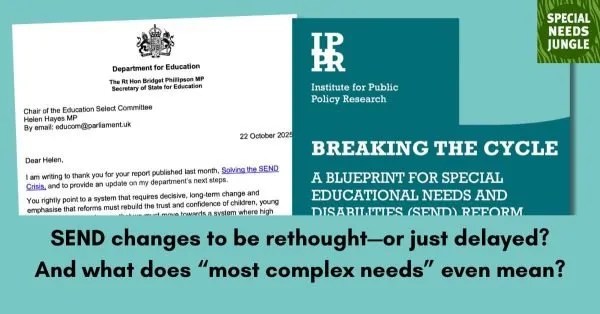
I do try to start every blog with some happy news from the world of education. This Tuesday, I joined a nationwide on-line meeting with the Minister of State (Minister for School Standards) at the Department for Education, Georgia Gould, around the need for ‘Local’ SEND reform. I applaud the Minister for making herself available for a succession of similar events, all to form part of the country’s need to ensure all children in nurseries and schools get the support needed to ensure their school years are successful.
The trouble with the process of reform now underway is that the scale of the problem is so vast that reforming the identification of children who need additional support simply won’t cut it. Scotland’s analysis of the situation shows that 43% of children fall into this category, representing a doubling of need over just the last 10 years. The situation is measured differently in England, where the statistics (21% with SEN) cover a higher severity of need before being recorded. However, the almost doubling of spend over the last 5 Years for High Needs funding is indicative that the challenges are rapidly increasing in England too, and if it were measured by similar parameters to Scotland, the % would be pretty similar.
Teachers’ leaders have previously said that schools were being overwhelmed by an “explosion” in children with additional support needs, including dyslexia, ADD and ADHD. What has been abundantly clear for over 15 years now is that access to the professional identification of learning differences and difficulties has become so delayed and so costly that children’s needs reach crisis level before appropriate diagnosis and treatment plans to enable interventions to start.
Commenting on the government’s response, chair of the Parliamentary Education Select Committee Helen Hayes said: “We understand that the government isn’t in a position to answer our report’s recommendations in detail whilst it is still developing its SEND reforms. However, the current response will only suffice as an interim response because it does not directly address any of our report’s recommendations in the way that is expected of an official response to a Select Committee inquiry.”
Statisticians describe the distribution of populations as being covered by a bell curve, of which the following is an example. Standard deviation (STD) shows the expected differences between what’s normal and what’s not, and in terms of additional need, the graph below shows for needs in school, there is a top and tail that would usually require our attention, but that 90% should be described as normal.
In 2025, the Bell curve for children’s needs has been badly shifted, looking far more like the following:
Essentially, this is demonstrating we now have a school system that is now longer offering the provision needed for a significant minority of the population. This is where the toxicity of government policy to reduce the spending on children’s services since 2010 and the subsequent toughening up of academic standards in schools since 2014 have really begun to bite. And this is not just because of the growing awareness of parents that their children are struggling to meet the academic standards expected of them for reading, writing, numeracy and broader reasoning at ages 7, 11, 14 and 16. When you look at the underlying cause of children’s struggle, the major common single reason for children and adolescents listed is “social, emotional or behavioural difficulty”.
The Independent sector in England recognises these difficulties far more rapidly, such that earlier interventions take place and at an earlier age. As our pupils rise up through the various developmental stages of children’s development, so more precise identification of the specific challenges takes place. You can see this is the sector’s recognition of access arrangements (EAR) for public examination. The Labour government started bleating that our sector is a softer touch for giving out EARs; the clarity of these statistics highlight our children get the legal support they need and that it’s the state sector that’s lagging behind.
So what’s the solution then?
Return the Investment in Early Years Health Visiting in England to previous levels, this has significantly declined since 2015, marked by substantial cuts to the Public Health Grant, leading to a dramatic workforce reduction (nearly 40% by 2022), increased caseloads, missed mandated child reviews, and widespread service pressure, despite growing evidence of need and calls for increased funding to support early child development.
Increase English state school budgets back to 2010 levels; these have seen significant real-terms declines per pupil since 2009-10, with cuts averaging 9% by 2019-20, impacting secondary schools more (9%) than primaries (2%), and even more severely in deprived areas, leading to squeezed resources, staff shortages, and increased dependency on loans, despite government pledges to restore funding, as rising costs for energy, staff, and SEND needs outpace funding increases, creating a sustained crisis. Schools face an estimated £1.8bn shortfall in core funding this last year, impacting staffing and resources.
When the government of the day seeks independent advice, act on it! After COVID, the Conservative government appointed Sir Kevan Collins to recommend a comprehensive education recovery plan. His proposals, costed at approximately £15 billion, included:
Funding for an extra 100 hours of teaching per pupil.
Extending the school day by 30 minutes for a fixed, three-year period to allow for both academic and extracurricular activities like sports, music, and the arts.
Significant investment in the teaching profession and targeted academic support, primarily through tutoring.
Prioritising support for early years and mental health & wellbeing.
The government ultimately announced a much smaller package worth an initial £1.4 billion, which Sir Kevan described as “far short of what is needed”, “too narrow, too small and will be delivered too slowly”, leading to his resignation in June 2021.
Whilst I applaud the current government’s initiative to resolve the SEN funding issues in local authorities, essentially bankrupted already by the mounting costs of the ‘High Needs’ they face, taking a further 3 years to change the rules simply means the crisis will get worse in the meantime.
And finally, the Labour government’s policy, which has added 20% VAT to independent school tuition fees for 12 months now, is clearly yet another ‘Lethal Mutation’. Flagged up as a way for funding 6,500 more teachers into the state sector, the UK Parliament’s cross-party Public Accounts Committee (PAC) found that the Department for Education (DfE) lacks a “coherent plan, suitable targets and sufficient evidence” to increase the number of teachers. The committee criticised the department for failing to outline how it will achieve its manifesto pledge to recruit an additional 6,500 teachers.
So what can Independent school parents, teachers and alumni do now to ensure their voices are heard, to add to the political pressure heads and school associations have focused on their local MPs as well as the national government? Make the step by joining the Association for Families of Independent Schooling (AFIS). AFIS is the only membership organisation that brings together families who choose and value independent education in the U.K. and British international schooling. Their work supports their member families and the wider sector by championing choice, fair representation, and greater access to independent education.
It’s FREE to join AFIS as an individual, a family or a school. As the Academic Principal, I have joined our school as a founding partner of AFIS, and together with many other heads in due course, will encourage AFIS to grow in influence to support our communities even more fully. Our school is already recognised as a pioneering AFIS Foundation Partner School, one of the very first in the UK.
For enthusiasts of Trivia and Pub Quizzes, please check the last section of this Blog on the song.
We’ve just a couple of weeks left to the end of term, and all 3 schools are all set for the season, with trees, ivy, lights and decorations everywhere, and probably ‘Songbird Supreme’, Mariah Carey’s dulcet tones reminding us that Christmas is much more about people rather than presents. What’s worth our children knowing is that Maria Carey writes almost all of her songs herself, starting during junior school, and that writing has captured her a handsome net worth of $225 million. I guess that might make her children, twin girls, Moroccan and Monroe, a bit more ambitious for their gifts than the rest of us.
Clearly, our young family members won’t have those kinds of expectations, nor perhaps have ‘Oompah and Granny’ top buyers on their list of prezzies wanted. What’s more important, as the lyrics go, is wanting the humans there in the mix. Coming together across the ‘break’ certainly works for Family Wilding, though perhaps by the close of ‘Twelfth Night’, it’s time to move on for us all.
ClairesCourtTV features this week the topic “Surviving Christmas. As families around the world prepare to celebrate Christmas by decorating their homes, singing carols, buying gifts and planning feasts, often the true meaning of Christmas can be lost due to the commercial exploitation of this time of year. Many people see it as a joyous occasion to spend with family and friends, but for others, it is viewed as a stressful and challenging time attributed to a combination of factors such as financial pressures, relationship issues, and, quite often, loneliness.
Perhaps more importantly for parents is to set sufficient boundaries around their children’s access to social media, and best of all, keep them in the real world rather than alone in the digital space, where virtual friends are certainly not always the best influence, or even actually known! Mariah’s early life was spent largely with her mother. Although Carey looked forward to Christmas every year, she said in 2019 that her “dysfunctional family” and financial struggles in childhood often overshadowed her excitement. “I always wanted to have a really good time at Christmas, and they would ruin it, so I vowed in my own life I would make sure every Christmas was great.” She says it’s these struggles that gave her the encouragement to write, to express herself and find her true voice.
There are so many traditions at this time that are really worth observing across the family. I feel very sorry for the population of Denmark that at the end of this year, it is closing down its Postal Service at the end of December, so presumably the few left who choose to send Christmas cards have this as their last opportunity. Here in the UK, it seems we share 1 billion each year, with 150 million posted through the Royal Mail. How on earth do Danish children send their ‘thank you’ letters?
The physical act of writing on paper is now understood to be one of the key features of successful learning, with the latest research highlighting that screen-based memory decays so quickly that the average writer can’t remember what they typed 10 lines previously. However painful it is, helping children write their own lists, cards and letters, as well as to develop their personal signature, does every youngster the greatest service.
Staying smartphone-free is a great ambition for our youngest, and readers may have already heard of the move in Australia from next week (10 December) to ban anyone under 16 from keeping or making accounts on social media apps like TikTok, Instagram, YouTube, Snapchat, X, Facebook and more. Prohibition in isolation of course, never works, so nations that go down this route need to provide suitable alternatives. Just as England has been moving up in terms of its literacy and numeracy skills, Sweden’s overfocus on e-learning has seen parents and teachers really worry about their children’s inability to focus and work in school successfully.
As a consequence, Sweden is reintroducing printed textbooks and handwriting in schools to address this declining student literacy and concentration, reversing a previous trend of relying heavily on screens & devices. The government has invested millions of euros to buy new textbooks and is encouraging less screen time, particularly for young children, citing concerns that digital tools have led to reduced focus, comprehension issues, and a decline in basic skills.
Here in the UK, as well as in the USA, austerity in state school budgets is giving rise to similar concerns, with the literacy divide becoming more acute between the various socioeconomic layers, where access to physical books differs significantly. Ultimately, the signs are really clear; as adults, we must model, as best we can, reading and writing, thinking and expressing our views to each other, because that, it turns out, is how children acquire the skills they need best of all.
Back in 1967 or thereabouts, when brother Hugh and I were writing our lists for Father Christmas, or Dad kept us guessing about the ‘8 legs he had bought for the family present. He had taught my brother and me how to play snooker at the various hotels we stayed in over the summers. When he asked us to hop in the Commer Van we used for transporting us boarders between Ridgeway to collect said gift, we were certain that we were to collect our hearts’ desire. Instead of a showroom, we turned up at a kennels, and picked up 2 black poodles, Claude and Eustace, the first school dogs to join our community.
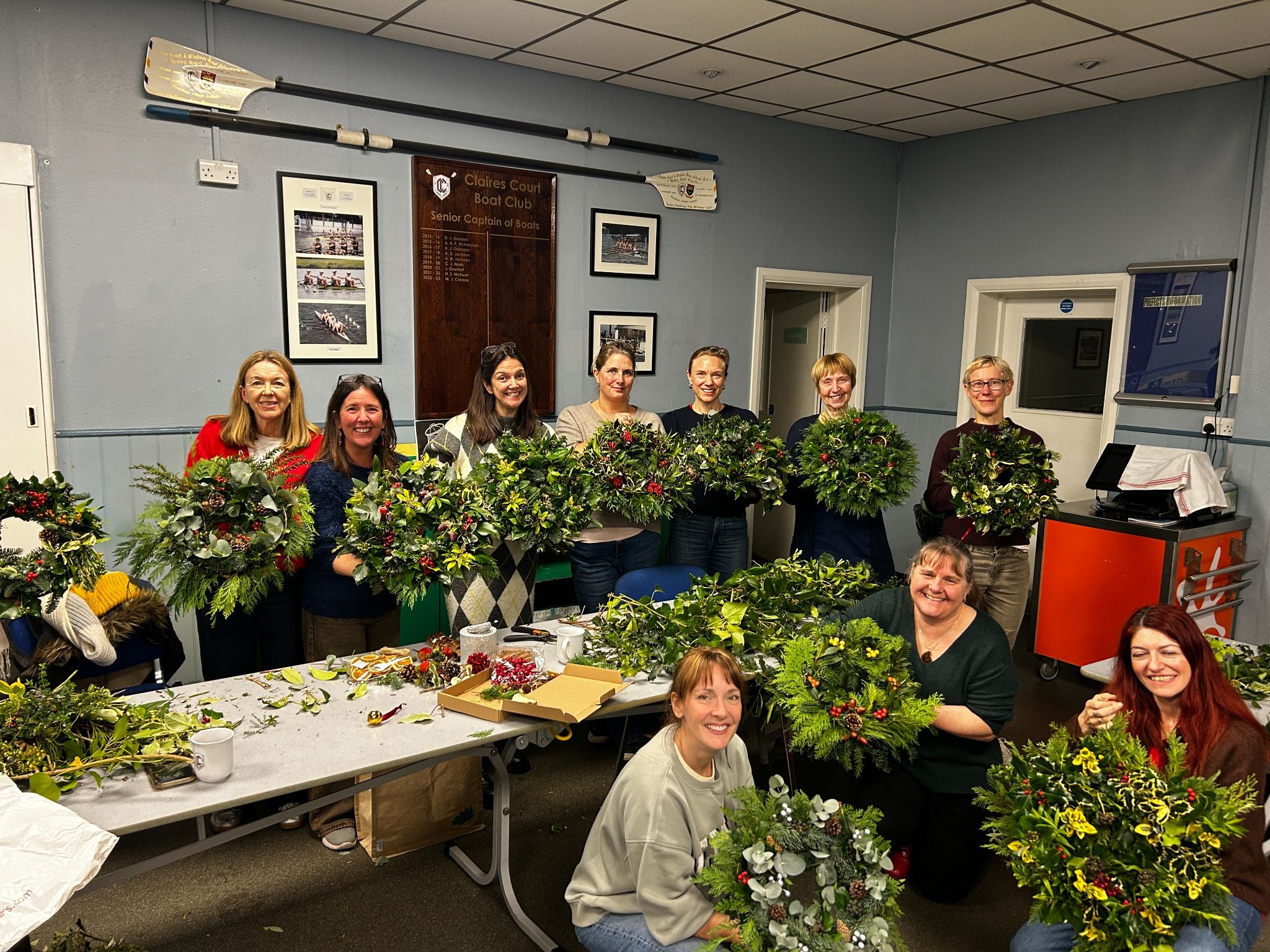
And finally, this Wednesday evening the sailing squad ran their annual fund-raising winter-warmer and wreath-making at the Senior Boys’ school. Over 2 hours, the parents transformed from willing amateurs to gifted professionals, as the closing snapshot below of their work reveals.
P.S. If anyone wants to buy said Sailng Squad one extra of the additional fireflies they need for national team racing, they can check that out in Santa’s basket here – https://ovingtonboats.com/firefly
Trivia
Written in 1994 with Walter Afanasieff, her record producer, and released on her album, “Merry Christmas”, these days Mariah’s dulcet tunes are to be found universally around the shopping centres and favourite seasonal downloads. For those shortly to take part in Pub Quizzes, the other key bits of information are:
The song was released in 1994 but didn’t reach the top spot in the UK until 2020 and in the US in 2019, after 25 and 26 years respectively, 70 weeks in the UK Top 100 and 16 weeks at number one on the Billboard Hot 100.
Billboard No. 1 of the Greatest of All Time Holiday 100 Songs—ahead of legendary vocalists like Bing Crosby, Brenda Lee, and Nat King Cole.
Mariah Carey wrote 18 of the 19 songs listed by Billboard, and she holds the record for the most cumulative weeks spent at number one as a songwriter.
It’s the song that just keeps giving, annual royalties an estimated $2.5-$3 million.
YouTube downloads to date (Noon, Thursday 4/12/2025) are 805,582,218.











 A Principled view